
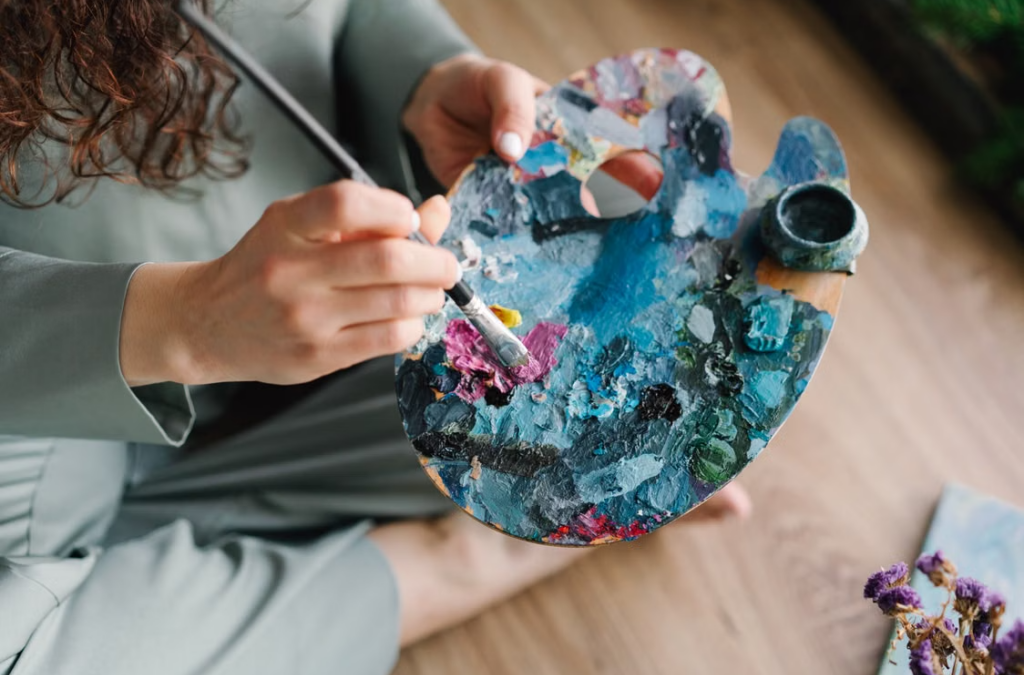
A painter may repeat the same mark because rhythm matters, erase it because the composition feels off, or return to one motif for years. From the outside, that repetition can look ritualized. For someone living with obsessive-compulsive disorder, however, the more useful question is what pressure is driving the action.
That distinction sits at the center of art therapy for OCD. In clinical practice, art therapy combines creative work with psychological theory within a therapeutic relationship led by a qualified practitioner. The therapist attends to the creative process, the person’s responses, and the goals of care rather than treating the finished image as a diagnostic object. Art may create room for expression and observation, although direct evidence that it reduces OCD symptoms remains limited.
Three practices that should not be collapsed
Several different activities are often described as therapeutic, even though they serve different purposes:
- Personal art-making may be relaxing, meaningful, or part of a daily routine. It does not require a therapist, and its value does not depend on changing symptoms.
- Art therapy involves a qualified practitioner, agreed goals, consent, and attention to what happens during the creative process. Artistic skill is not the point.
- OCD-focused care directly addresses obsessions and compulsions. It commonly includes cognitive behavioral therapy with exposure and response prevention, known as ERP. Medication may also be appropriate for some people.
These approaches can exist beside one another while serving different purposes. Personal art-making may sit alongside other OCD coping skills, while art therapy and ERP involve distinct therapeutic goals and professional boundaries. A quiet hour with a sketchbook is different from working with an art therapist, and neither should be presented as a replacement for established OCD care.
Repetition is not the whole story
Art history offers many examples of repetition used as a deliberate visual language. Yayoi Kusama’s Infinity Nets turn recurring brushstrokes into fields that suggest endless space, while Sol LeWitt’s wall drawings use written instructions and repeated marks to make process part of the work. In these examples, repetition operates as composition, method, and duration. With OCD, the clinically relevant question is different: whether an action is driven by distress, feared consequences, or a rigid demand for certainty.
OCD involves recurring, difficult-to-control thoughts, images, or urges called obsessions, along with repetitive behaviors or mental rituals called compulsions. Compulsions are often performed to reduce distress, gain certainty, or prevent a feared outcome. The temporary relief they provide can reinforce the cycle.
Diagnosis depends on the broader pattern of symptoms, distress, time, and interference with daily life. A person’s imagery, preferred materials, perfectionism, or studio routine cannot establish that they have OCD.
Within an art practice, these questions can help clarify the function of repetition:
- Can the person change or stop the action by choice?
- Does repeating the mark serve an artistic idea, or is it meant to neutralize fear?
- Is reassurance being sought about what the finished image supposedly means?
Their purpose is to guide a conversation about function, choice, distress, and context. Diagnosis requires a broader clinical assessment that considers time and interference with daily life.²
The canvas as a place to notice process
In a well-bounded session, paint, clay, collage, or another material may give shape to an experience that feels difficult to explain. The therapist can notice when uncertainty, self-criticism, or an urge to correct appears. This may make the sequence easier to discuss, without assuming the artwork contains a hidden answer.
The therapist can explore how the person responds to an image without assigning it a fixed symbolic meaning. Intrusive thoughts and images are symptoms of OCD rather than reliable evidence of intent, character, or personal values. Treating every visual detail as psychologically revealing may increase attention, rumination, or doubt.
Creative work may sometimes be incorporated into a professionally planned exercise involving flexibility, uncertainty, or incompleteness. Once an activity is intended to trigger an obsession or prevent a compulsive response, it begins to overlap with ERP and should be coordinated with an OCD-trained clinician rather than improvised as a studio challenge.
What the evidence says about art therapy for OCD
Research specifically examining art therapy for OCD remains limited. A broad review of psychotherapies and emerging interventions concluded that art and music therapy may have potential as complementary approaches, but that their evidence base is very small.
A 2026 case report followed one woman with contamination-related OCD during a ten-week art therapy process and described reductions in compulsive behavior and anxiety.⁷ Because the report involved a single participant and lacked a controlled comparison, it cannot establish that art therapy is effective for the wider OCD population.
Current evidence continues to support ERP, usually delivered within cognitive behavioral therapy, as a first-line psychological treatment for OCD. Art therapy may have a complementary role when it is delivered by a qualified practitioner, has clearly defined goals, and is coordinated with OCD-informed care.
Boundaries matter when art meets symptoms
Art-making can sometimes become folded into a compulsive cycle. Someone might repeatedly restart a piece until it feels safe, check an image for hidden meaning, or seek repeated confirmation that the work says nothing troubling about them. Repetition becomes clinically relevant when it is governed by a rigid demand for certainty, safety, or immediate relief.
A thoughtful therapist should avoid becoming a source of repeated reassurance or assigning fixed meanings to colors, symbols, or subjects. Art therapy techniques should be selected according to the person’s goals and responses: an open-ended prompt may encourage flexibility for one person while inviting rumination for another.
Anyone who feels destabilized by an exercise is allowed to pause and discuss what happened. Pushing through without a clear clinical purpose is not a measure of effort or courage. Coordination with an OCD-trained mental health professional is especially important when art activities begin touching the obsession-compulsion cycle.
Questions worth bringing to a first conversation
Before beginning art-based work, consider asking:
- What qualifications and professional credentials do you hold?
- What experience do you have with OCD and ERP?
- Is art therapy meant to supplement my current care?
- How will you prevent an exercise from becoming another ritual?
- How do you handle interpretation, privacy, and rising distress?
Clear answers matter more than confident promises. A responsible practitioner should be able to explain the purpose and limits of the work without suggesting that a particular material, prompt, or image can reveal or cure a disorder.
A grounded place for art
Art can hold personal, cultural, and aesthetic value independently of measurable symptom change. It may remain a private practice, a source of beauty, or a structured way to communicate. Within therapy, the creative process can also provide a visible setting for discussing pressure, uncertainty, and choice.
For someone with OCD, progress may involve gaining more room to choose an action rather than automatically following a ritual. Art therapy may support that larger process, but its role should remain complementary, carefully bounded, and coordinated with appropriate professional care.
This article is for general education and is not a diagnosis or a substitute for individualized care from a qualified health professional.
Safety Disclaimer
In the United States, if you or someone you love is in crisis, call 911 or go to the nearest emergency room. You can also call or text 988, or use the 988 Suicide & Crisis Lifeline chat. Support is free, confidential, and available 24/7.