
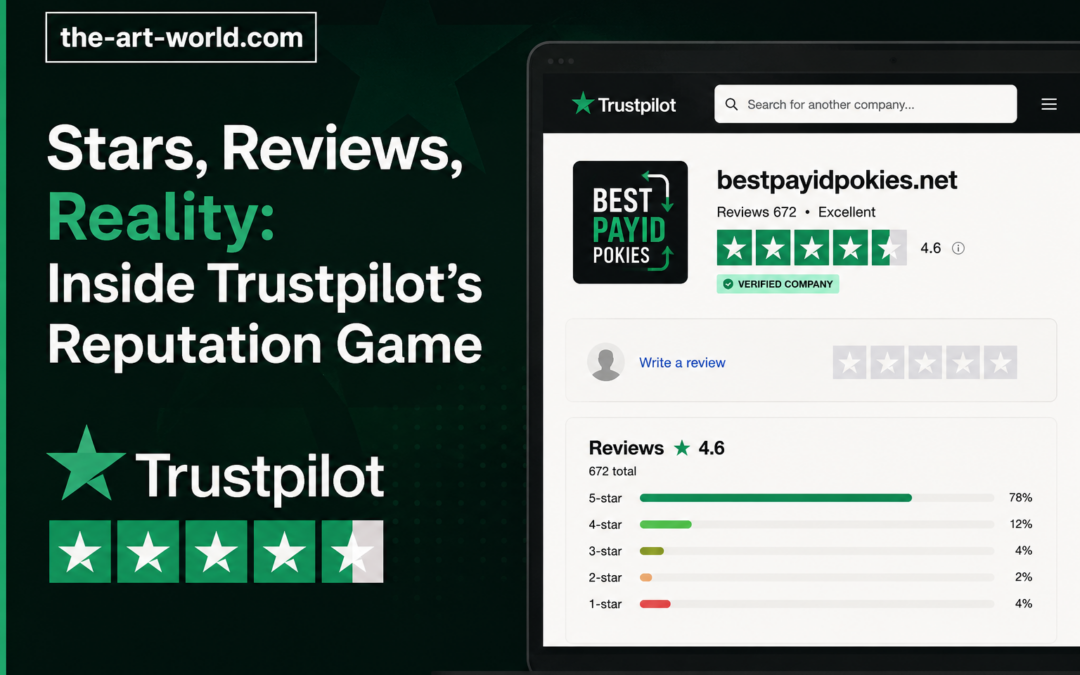
Review platforms have become a primary layer of consumer due diligence. Before booking a hotel, choosing a software tool, or selecting an online casino, most people check what others have said. Trustpilot sits at the centre of this behaviour — collecting millions of verified and unverified reviews across virtually every industry. But how well do those stars actually reflect reality? And what happens when the industries being reviewed operate in a space where trust carries financial weight?
How Trustpilot Builds — and Risks — Its Credibility
Trustpilot was founded in Denmark in 2007 with a straightforward goal: give consumers a place to share honest experiences and give businesses a measurable reputation signal. Today, the platform hosts over 300 million reviews and operates across more than 100 countries. Its open model allows anyone to leave a review, which is both its strength and its most persistent criticism.
The platform distinguishes between invited reviews — triggered by a business after a transaction — and organic reviews posted voluntarily. According to Trustpilot’s transparency reports, invited reviews tend to score higher on average, partly because businesses selectively invite reviewers. This does not automatically imply manipulation, but it does mean that the average star rating often skews more positive than a fully neutral sample would.
Trustpilot employs automated fraud detection alongside a manual content integrity team. Fake reviews — whether positive ones posted by the business itself or negative ones planted by competitors — violate platform policy and can result in account suspension. Still, independent analyses by consumer watchdogs have repeatedly found uneven enforcement. Some flagged reviews remain live for months; others are removed without explanation.
What the Star Rating Actually Measures — and What It Doesn’t
A 4.7-star rating on Trustpilot tells you that a business has received mostly positive reviews. It does not tell you the number of negative experiences that went unreviewed, the demographics of those who left feedback, or whether the business resolved complaints privately to prevent public damage.
The rating is a snapshot, not a comprehensive audit. Experienced readers learn to weigh recent reviews more heavily, look for patterns in negative feedback, and check how the business responds to criticism. A company that replies to every one-star review with a personalised, solution-oriented response earns a different kind of trust than one that ignores dissatisfied customers entirely.
This is especially relevant in sectors where the transaction carries real financial risk. Online gambling is one such sector — and it generates a distinctive kind of Trustpilot activity.
Gambling on Trustpilot: Wins, Rage, and Nothing in Between
Casinos and gambling-adjacent platforms attract a particular type of reviewer. Players tend to leave feedback at emotional extremes: after a significant win, or after a withdrawal is delayed. The middle ground — ordinary sessions with no drama — rarely generates reviews at all.
This creates a structural skew. Trustpilot profiles for gambling platforms often contain a cluster of five-star reviews praising fast payouts and smooth gameplay, alongside a cluster of one-star reviews about frozen accounts and refused withdrawals. The three-star experience — functional but unremarkable — goes largely undocumented.
For readers trying to interpret these profiles intelligently, a few factors matter most: how the business categorises and responds to complaints, whether negative patterns repeat over time, and whether the platform operates transparently about its terms and payment structures.
The following signals are worth examining before trusting a gambling platform’s Trustpilot score:
- Volume relative to age — a new platform with 500 reviews in two months warrants scepticism
- Response quality — generic copy-paste replies signal disengagement from actual complaints
- Review clustering — a spike of five-star reviews over a short window may indicate a solicitation campaign
- Recurring complaint themes — withdrawal delays, verification loops, and bonus disputes appearing repeatedly across different usernames are structural red flags
- Verified purchase indicators — platforms that invite reviews only after confirmed transactions generate more reliable data
No single signal here is conclusive on its own. The value comes from reading them together: a platform that scores poorly on three or four of these dimensions simultaneously is giving a clear answer, regardless of what its headline star rating says.
Trustpilot as a Research Tool, Not a Verdict
The most useful way to approach Trustpilot is as a starting point for research rather than a final answer. A profile with a strong rating is worth exploring further; a profile with a weak rating may still represent a legitimate platform handling an unusually vocal negative minority.
That approach is particularly relevant for comparison sites and payment-focused guides, where the credibility of the research itself becomes part of the trust equation. A platform that ranks casinos by payment reliability cannot afford to treat its own Trustpilot presence as an afterthought — the way it handles feedback signals whether its standards apply to itself as much as to the operators it evaluates.
Bestpayidpokies.net — which analyses payment methods, casino reliability, and player experiences across the Australian online gambling market — is one example of a platform where this consistency shows up in practice. The site uses its own Trustpilot profile as a transparent feedback channel, not a marketing tool. Reviews left there reflect genuine player interactions with the platform’s research and recommendations, which gives the profile a different character than a typical operator page.
The site’s editorial approach draws on community signals, including Trustpilot activity, alongside regulatory data and technical testing. Writing for the-art-world.com, we’ve covered how platforms like bestpayidpokies.net represent a distinct category — not casinos, not aggregators in the traditional sense, but analytical guides that hold themselves accountable to the same review infrastructure they use to evaluate others.
From Trust Signals to Payment Decisions
The logical endpoint of evaluating a gambling platform’s Trustpilot presence is a payment decision. Trust, at its most practical, is what makes a player willing to deposit money. Verification of that trust — through reading other people’s experiences, checking complaint patterns, and assessing response quality — is what allows that decision to be informed rather than impulsive.
That process flows naturally toward one of the most practically important questions in Australian online gambling: which payment methods work reliably? Reviews on platforms like Trustpilot consistently show that payment friction — slow deposits, failed withdrawals, opaque processing times — is the single largest driver of negative feedback. The analysis at bestpayidpokies.net focuses specifically on PayID pokies, examining which platforms support instant bank transfers via PayID and whether real-world player experiences, including those documented on Trustpilot, align with operators’ claims.
The-art-world.com has explored how the intersection of financial technology and consumer trust platforms is reshaping expectations across multiple industries — and online gambling is among the clearest examples of that shift.
Does Trustpilot’s Star System Actually Reflect Reality?
The honest answer is: sometimes, and imperfectly. Trustpilot’s infrastructure is genuine, its fraud-detection systems are functional, and its data — when read with critical attention — contains a real signal. The problem is not the platform itself but the assumption that a number between one and five can fully capture the complexity of a service relationship.
For gambling platforms specifically, the star rating matters less than the composition of what sits behind it. Responsible readers do not stop at the headline score. They look at what is being complained about, how often, and whether it is being addressed. Platforms that engage honestly with criticism — including on their own Trustpilot profiles — tend to earn the kind of long-term credibility that a manufactured five-star average cannot sustain. That distinction, ultimately, is what separates reputation from reality.